Many language learners are trapped in a cycle of “permanent studenthood.” They have spent years attending classes, yet they still feel paralyzed without a textbook or a teacher to guide them.
As a Language Consultant, my goal is the exact opposite of a traditional school: I want to make myself unnecessary. The hard truth is that many traditional classes move at the speed of the slowest student. They rely on “spoon-feeding” you information in a way that creates a dependency on the instructor. But true fluency isn’t a performance for a teacher—it is Language Autonomy. It is the ability to navigate a foreign environment using your own internal compass.
True fluency requires Language Autonomy—the ability to navigate a foreign environment using your own internal compass. But you can’t be autonomous if your foundation is weak. Before mastering these pillars, you must first transition from a student mindset to an architect mindset by building a personalized language learning system.
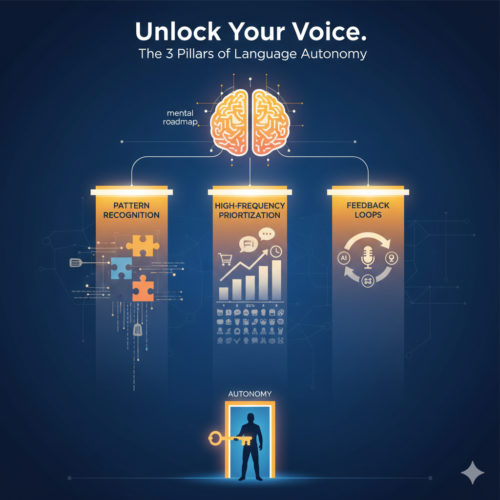
To reach that level, you must master the three pillars of autonomous acquisition.
Pillar 1: Pattern Recognition (The DNA of Language)
Traditional education forces you to memorize hundreds of isolated grammar rules. This is like trying to learn how to build a car by memorizing a list of every single bolt and screw. It is overwhelming and inefficient.
The Consultant’s Strategy: Reverse Engineering Instead of studying rules, you must learn to spot the DNA patterns that appear in 80% of daily conversations. Most languages rely on a small handful of structural “hacks” that, once seen, cannot be unseen.
- Consultant Tip: When you hear a native speaker say something you don’t quite understand, don’t ask for a grammar rule. Reverse engineer the sentence. Look at the word order and the endings. Once you identify the pattern, you can “copy-paste” that logic into a thousand other sentences.
Pillar 2: High-Frequency Prioritization (The 80/20 Rule)
Have you ever noticed that “Week 1” in a language class is usually spent learning the names of colors, kitchen utensils, or zoo animals? This is a waste of your cognitive energy.
The Consultant’s Strategy: The Pareto Principle In any language, roughly 500 words cover the vast majority of daily interactions. A Language Consultant doesn’t teach you the word for “spatula” until you have mastered the 500 high-frequency words that allow you to survive 90% of real-world situations.
- The Action Plan: Stop following a generic curriculum. Prioritize the vocabulary that matches your life and your needs. If you can’t navigate a grocery store or express a basic “want” or “need,” you shouldn’t be learning the names of exotic birds.
Pillar 3: Feedback Loops (The Self-Correction Muscle)
The biggest fear learners have is “making mistakes.” This is why they stay dependent on teachers; they need someone to tell them they are wrong. However, fluency is built through the Self-Correction Muscle.
The Consultant’s Strategy: Building Your Own Mirror You don’t need a human standing over your shoulder to correct every syllable. You need a systematic feedback loop. * The How-To: Use modern tools to become your own critic. * Shadowing: Record yourself mimicking a native speaker and play it back. Your brain will naturally begin to spot the “gap” between your sound and theirs. * AI Diagnostics: Use AI tools to check your written patterns. * The Goal: Every time you notice your own mistake, you are practicing autonomy.
Conclusion: Becoming Your Own Consultant
My job isn’t to be your crutch; it’s to teach you how to walk on any terrain. When you stop being a student and start being an architect of your own learning, the “privilege” of expensive schools disappears. You realize that the language is already learnable—you just needed the keys to the car.