

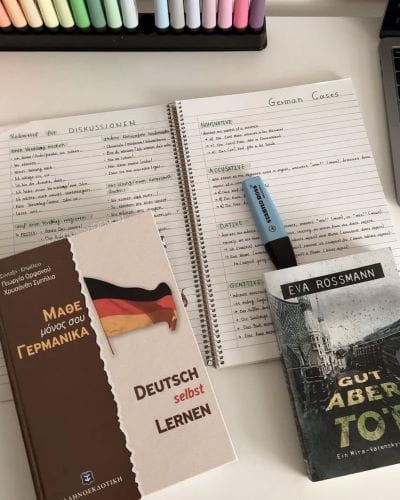
If you know German grammar but still freeze when it’s time to speak or write, your problem isn’t a lack of knowledge—it’s a lack of automation. By shifting focus from individual grammar rules to collecting and practicing whole linguistic structures, you can bypass mental translation, build immediate confidence, and rapidly accelerate your active fluency.
The Trap of Knowing Too Much Grammar
I have been learning German for a year and a half now. For a long time, I felt like I was doing everything right. I memorized the cases, tackled the genders, and unlocked the complex word order rules.
On paper, my German was great. I could read blogs, watch videos, and understand a surprising amount of the language.
But the moment I opened my mouth to speak or sat down to write an email? Complete paralysis.
My brain would instantly go into overdrive: “Is this dative or accusative? Wait, what gender is this noun? Where does the verb go if I use ‘weil’?” I spent so much time calculating the math of the language that I ended up saying absolutely nothing. I was stuck in a frustrating limbo for months.
The Real Problem: Knowledge vs. Automation
That is when I realized something crucial: My problem wasn’t the grammar. It was the automation of that grammar.
There is a massive difference between understanding a rule when you see it and your brain automatically firing that rule in a real conversation. When you try to build sentences word-by-word using grammar tables in your head, you will always freeze.
To break the wall, I had to stop studying rules and start studying structures.
The Structure Blueprint: How I Accelerated to B1
I completely changed my daily routine. Instead of opening a textbook, I turned to real German content (videos and articles) and used a simple, three-step system:
1. Catch 5 to 7 Structures a Day
Whenever I watched a video or read a text, I stopped looking for individual vocabulary words. Instead, I looked for complete sentence patterns. For example, instead of just learning the word abhängen, I wrote down the whole structure: “Das hängt von … ab.”
2. The 10-Sentence Muscle Memory Rule
For every single structure I found, I sat down and wrote 10 unique sentences using it. This forced my brain to use the pattern in different contexts until the grammar inside it became automatic. [If you don’t have a native speaker to check your work, you can easily use AI to practice writing and get instant corrections on your sentences] I didn’t have to think about the cases or prepositional rules because the phrase became a single, solid tool in my toolkit.
3. The 150-Word Stack
Once I felt confident with those individual structures, I challenged myself to combine them. I would take the patterns I learned that week and weave them together into a short paragraph of 100 to 150 words.
The Results: From Frozen to Fluent
The shift was almost magical. By focusing on chunking structures instead of memorizing rules, my writing and speaking confidence skyrocketed. I wasn’t guessing anymore; I was using proven blueprints that I knew were correct.
Using this exact method, I broke through my long-standing plateau and reached a solid B1 level in just a single month.
If you are currently staring at a blank page or freezing mid-sentence in German, stop studying the tables. Pick up a notebook, find 5 structures today, and write your way out of the trap. You already have the pieces—you just need the blueprint to connect them.
Great content! Keep up the good work!